Blockchain4AgroBiodiversity · B4AB

ReSeedd

Exploring responsible digital and institutional approaches to incentivize the in situ conservation of agrobiodiversity, recognize Indigenous Seed Knowledge, enable know-how exchange, and support farmer-led innovation. The ReSeed project ("Blockchain for Biodiversity") is funded by the European Research Council Starting Grant with Dr. Mrinalini Kochupillai as Principle Investigator (PI). The project is supported by the United Nations Food and Agriculture Organization (UN FAO) and the International Association for Human Values (IAHV).

01 / about

About

ReSeed:Blockchain4AgroBiodiversity

The Blockchain4AgroBiodiversity research project (B4AB) explores how potential digital and technological solutions could support the conservation, recognition, responsible access and sharing, and continued sustainable innovation of Indigenous Seeds and associated Knowledge (ISK).

B4AB is grounded in broader principles of responsible research and innovation and works with farmers, researchers, communities, institutions, and other stakeholders to explore approaches that are fair, responsible, context-sensitive, and socially legitimate.

02 / mission, vision & values

Mission, Vision & Values

Mission

Our mission is to explore ways of supporting farmer-led conservation and innovation with Indigenous Seeds and associated Knowledge, while enabling provenance and traceability, various modes of recognition, responsible exchange, and fair Access and Benefit-Sharing (ABS).

Through interdisciplinary research and engagement with farmers and other stakeholders, B4AB investigates how digital technologies, governance arrangements, incentives, and legal frameworks can contribute to these goals in ways that are fair, responsible, context-sensitive and socially legitimate.

Vision

We envision a future in which the diversity of seeds, farming practices, and knowledge systems that sustain agrobiodiversity are recognized, protected, kept alive, and able to continue evolving.

In this future, farmers and local and Indigenous communities are not merely sources of biological or genetic resources and data, but recognized and respected contributors, knowledge holders and stewards, innovators, and participants in decisions about how their knowledge and resources are used.

Core Values

Farmer-Led Agrobiodiversity & Diversifying Knowledge and Value

We value farmers and communities who continue to conserve, cultivate, adapt, and innovate with Indigenous Seeds and associated know-how.

Equity, Recognition & Reciprocity

Those who conserve, develop, and contribute seeds and associated knowledge should be fairly recognized and should be able to share the benefits arising from their use.

Responsible and Context-sensitive Innovation

B4AB investigates technological and institutional arrangements in relation to their social, ecological, cultural, legal, and economic contexts.

Participation & Co-development

B4AB aims to involve farmers, researchers, practitioners, NGOs, public authorities, and other stakeholders in shaping research and governance approaches.

Trust, Stewardship & Responsible Access

B4AB seeks approaches that respect privacy, consent, community authority, ethical considerations, provenance, and appropriate limits on access and use.

03 / understanding reseed

Understanding ReSeed

Did you know?

It has been estimated that 75% of crop agrobiodiversity has already been lost, and three-quarters of the world's food comes from just 12 plant and 5 animal species. Agrobiodiversity is depleting at an alarming rate.

Agrobiodiversity, particularly farmers' Indigenous Seed Knowledge (ISK) and associated traditional knowledge, is fundamental to food security and sustainable agriculture.

Although seed banks help preserve seeds, declining seed viability and climate change make on-farm (in situ) conservation essential. Yet farmers may have limited incentives to conserve ISK, while systems for tracing its origin, access, use, and downstream research remain limited.

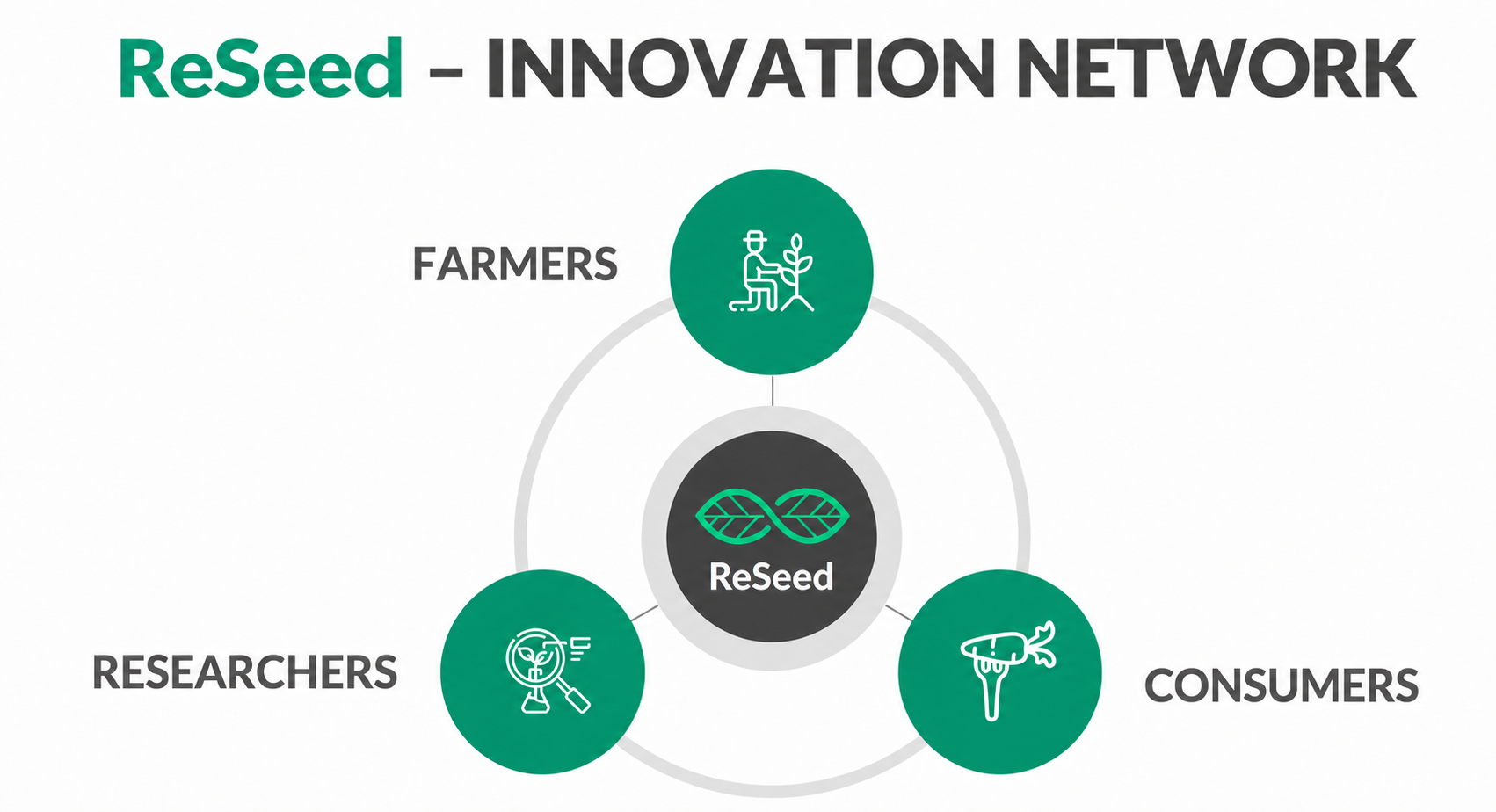
ReSeed is a farmer-centric research initiative supported by the UN Food and Agriculture Organization (FAO) that aims to build trust within Access and Benefit-Sharing mechanisms existing in international legal frameworks.

Explore ReSeed history →
04 / problem framing

Problem Framing

What problems is ReSeed trying to address?

01 — Rapid erosion of agrobiodiversity

Two-thirds of our current crop production comes from just nine species, making crops more prone to diseases and more susceptible to failure due to climate change.

02 — Lack of incentives and recognition

Farmers and communities may have limited incentives and recognition for cultivating, conserving, and continuously adapting local and heterogeneous seeds and associated knowledge.

03 — Lack of available local genetic resources

Researchers, farmers, and breeders may have limited access to diverse local and Indigenous seed varieties and associated knowledge that could support conservation, research, and innovation.

04 — Lack of information and traceability

Information about unique seed properties, provenance, cultivation conditions, pest and climate resistance, nutritional characteristics, and downstream use may be difficult to document, access, and trace.

05 — Lack of trust among agrobiodiversity holders and those seeking access

Limited transparency, recognition, and benefit-sharing can contribute to mistrust between farmers and communities who conserve seeds and associated knowledge and researchers, breeders, institutions, and other actors seeking to access or use them.

05 / these issues can be addressed together

These issues can be addressed together

How we tackle these issues

To address the issue of lack of trust in the system blockchain or Distributed ledger techonology (DLT) could guarantee privacy and full data control for farmers or farmer groups, while ensuring that that they receive the rightful compensation from any downstream use.

Immutable Record-Keeping

Persistent records could support greater transparency and traceability and contribute to trust among participating actors.

Distributedness

Distributed systems may support different forms of authority and participation and allow multiple governance structures to be explored.

06 / reseed approach

ReSeed Approach

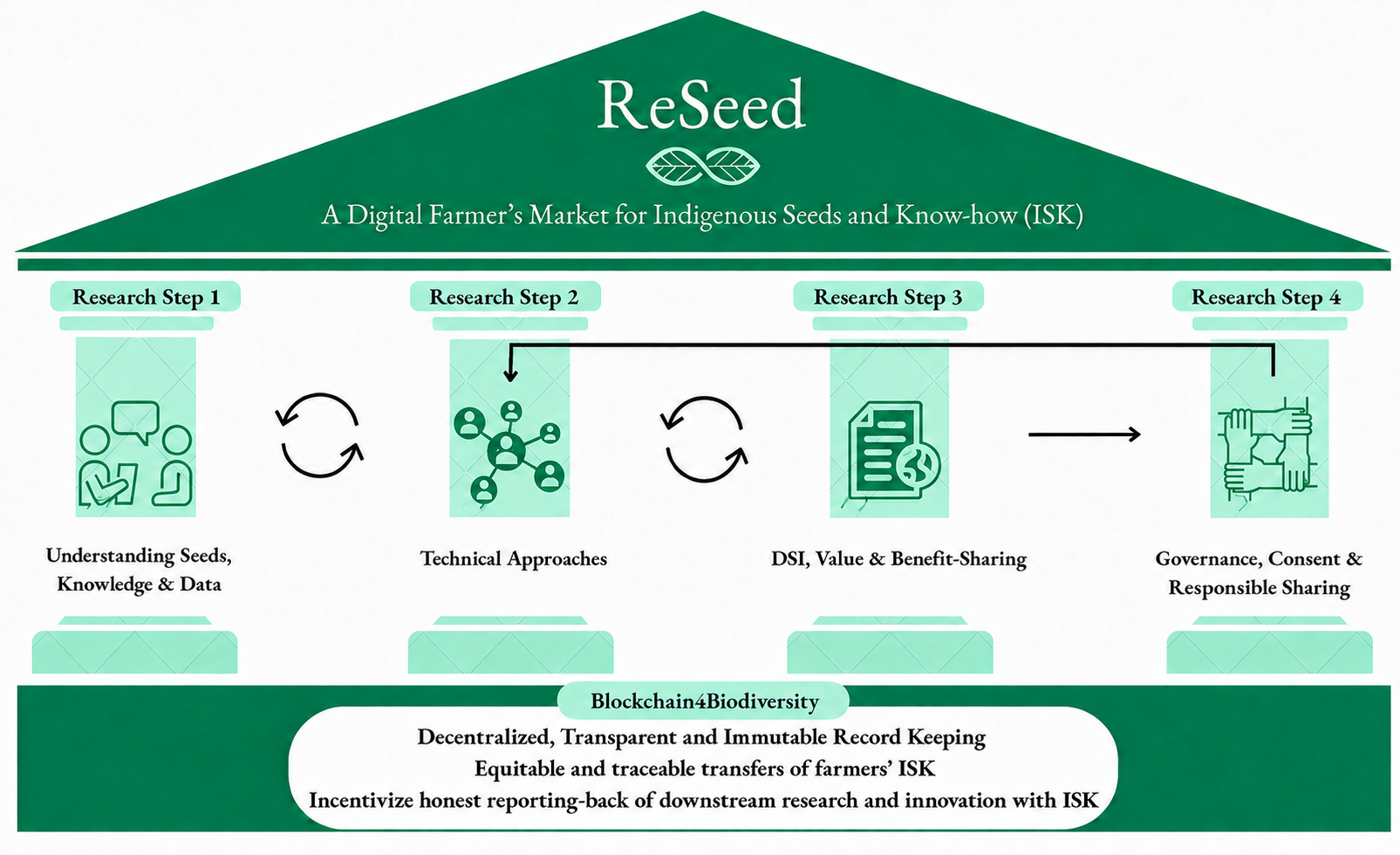
ReSeed investigates these challenges through four interconnected research areas

ReSeed House infographic
Research Step 1 — Understanding Seeds, Knowledge & Data

Co-compile data categories, technical features, and monetary and non-monetary incentives with buyers and sellers of ISK.

Research Step 2 — Technical Approaches

Compile and test ReSeed technical specification and technology stack using inputs from Research Step 1, 3 and 4.

Research Step 3 — DSI, Value & Benefit-Sharing

Demonstrate how ReSeed can be integrated into existing regulatory frameworks with minimal legal amendments.

Research Step 4 — Governance, Consent & Responsible Sharing

Co-create with ISK buyers and sellers, a governance model and ethical guidelines for adoption of ReSeed.

07 / research progress

Research Progress

Research Progress

ReSeed is an evolving interdisciplinary research project. Research activities, work-package developments, publications, reports, presentations, and other project outputs will be progressively documented on the Research page as the project develops.

View research progress →